
C-Salts® & the Pioneers of Vitamin C: Linus Pauling, Irwin Stone & Dr. Andrew Weil
The story of C-Salts® is deeply rooted in the pioneering history of vitamin C research. Developed by MIT-educated physicist and Wholesale Nutrition founder Oscar Falconi, C-Salts emerged from years of experimentation, scientific collaboration and a commitment to creating a better form of vitamin C.
Discover Oscar Falconi's personal friendship with two-time Nobel Prize winner Linus Pauling, his collaboration with pioneering vitamin C researcher Irwin Stone, his scientific correspondence with Dr. Robert Cathcart and the historical recommendations attributed to renowned integrative medicine physician Dr. Andrew Weil.
Explore original handwritten correspondence, personally signed books, historical photographs, newsletters, seminar materials and published references that bring the remarkable history of C-Salts® buffered vitamin C powder to life.
Shop C-Salts Buffered Vitamin COscar Falconi Linus Pauling Oscar and Linus's friendship Independent correspondence Irwin Stone Robert Cathcart Historic seminars Original formulation Andrew Weil Timeline FAQs
Oscar Falconi: The Founder of C-Salts

MIT-educated physicist, author and inventor
Falconi founded Wholesale Nutrition Club in 1970. His 1981 seminar biography identifies him as an MIT physics graduate and author of The Miracle of Vitamin C. His interest in nutrition brought him into contact with vitamin C researchers and physicians, and he organized educational seminars and published newsletters.
He developed C-Salts as a low-acid, sodium-free, economical and pleasant-tasting vitamin C powder containing calcium, magnesium, potassium and zinc. His September 1983 newsletter documents this formulation philosophy, which remains central to C-Salts today.

Oscar Falconi's 1981 Biography
Original Wholesale Nutrition Club seminar material identifying Falconi as an MIT physics graduate, author and company founder. Click the document to enlarge.
Linus Pauling and Oscar Falconi

Two-time Nobel Prize recipient and vitamin C advocate
Pauling's research on chemical bonding helped shape modern chemistry. He received the 1954 Nobel Prize in Chemistry and the 1962 Nobel Peace Prize, becoming the only person awarded two unshared Nobel Prizes. Neither award was for vitamin C.
His books Vitamin C and the Common Cold and Vitamin C, the Common Cold and the Flu brought vitamin C supplementation into widespread public discussion. His later hypotheses were influential but are not proof of clinical benefits.
Independent references: Nobel Prize in Chemistry | Nobel Peace Prize.
Among the documents preserved in the Falconi family archive is a personally inscribed copy of Pauling's book, Vitamin C, the Common Cold and the Flu.

Linus Pauling's Vitamin C Book
Original book preserved in the Falconi family collection.

Personally Inscribed to Oscar Falconi
The inscription reads: To Oscar Falconi — Linus Pauling.
Beyond Science: Oscar Falconi and Linus Pauling's Personal Friendship
According to the Falconi family, Oscar and Linus were friends as well as acquaintances in the vitamin C community. Their relationship included correspondence, shared scientific interests and private social gatherings. The family preserves a photograph and signed humorous note that Pauling personally gave to Oscar.

THUS OSCAR FALCONI MUST PAY $1.00
TO GUY LEBRETON”
Signed Linus Pauling; Falconi family archive.
The note offers a glimpse of the humor in their personal relationship through a friendly wager about calculator notation. Alongside the signed book, correspondence and newsletter account of Pauling's visit to Oscar's home, it provides context for the friendship described by the family.
A Personal and Professional Connection
According to the Falconi family history, Pauling contributed input during the development of C-Salts and spoke favorably about the product during the 1980s at seminars.
These recollections are part of the company's historical account. The surviving correspondence and signed materials document the relationship, although the precise extent of Pauling's formulation contributions and seminar recommendations remains under historical investigation.

Linus Pauling Visits Oscar Falconi's Home
Wholesale Nutrition Club Newsletter No. 14, published in January 1983, describes a November 1982 gathering celebrating vitamin C researcher Irwin Stone's 75th birthday.
Falconi recounts Pauling's attendance at the private gathering alongside several other prominent figures interested in vitamin C.
Source: Wholesale Nutrition Club Newsletter No. 14, January 1983.
Historical Correspondence Connecting Linus Pauling, Oscar Falconi and C-Salts
In addition to the documents preserved by Wholesale Nutrition, publicly accessible auction records provide independent documentation of Pauling's correspondence with Falconi and his awareness of C-Salts in the early 1980s.
Linus Pauling Writes to Oscar Falconi
RR Auction cataloged two signed letters from Pauling to Falconi dated 1971. In one, Pauling wrote:
RR Auction, Lot 248, October 15, 2014.
Linus Pauling Writes to Irwin Stone About C-Salts
A March 1981 letter cataloged by RR Auction records Pauling acknowledging Stone's correspondence about C-Salts.
Pauling also expressed his intention to try the product, noting that he had not yet done so at the time of writing.
RR Auction, Lot 247, October 15, 2014.
Together, these records document Falconi's correspondence with Pauling as early as 1971 and Pauling's knowledge of C-Salts by March 1981.
Irwin Stone and Early Vitamin C Research

Pioneering ascorbic acid researcher and author
Stone studied ascorbic acid and advocated greater attention to vitamin C in nutrition. His 1972 book The Healing Factor: Vitamin C Against Disease presented his historical theories. His correspondence helped inspire Pauling's interest in vitamin C supplementation.
Oregon State University's Pauling archives discuss Stone's influence on Pauling and credit Oscar Falconi for a photograph of Stone, providing independent context for Falconi's association with the vitamin C community.
Independent reference: Oregon State University archival blog: Irwin Stone.
Oscar Falconi's historical newsletters describe a close relationship with Stone spanning approximately fourteen years, as well as their involvement in vitamin C education and seminars.
In May 1984, Falconi published a personal tribute following Stone's death, reflecting on their longstanding friendship and discussions about ascorbate research.
The relationship between Falconi, Stone and Pauling provides important historical context for the development of C-Salts during a period of growing public interest in vitamin C supplementation.
Dr. Robert Cathcart and the Development of C-Salts

Physician and author on vitamin C tolerance
Cathcart published a 1981 paper in Medical Hypotheses discussing oral vitamin C intake in relation to gastrointestinal tolerance. His work was part of the historical debate about vitamin C supplementation; its hypotheses are not established clinical recommendations.
Publication: National Library of Medicine: Cathcart's 1981 paper.
One of the most significant documents preserved in the Wholesale Nutrition archive is a letter dated August 11, 1982, from Robert F. Cathcart III, M.D., addressed directly to Oscar Falconi.
The letter discusses the C-Salts formulation, including questions about buffering ingredients and a proposed adjustment to its calcium-to-magnesium ratio.
Robert F. Cathcart III, M.D., August 11, 1982

Original C-Salts Formulation Letter
August 11, 1982. Preserved in the Wholesale Nutrition historical archive. Click to view the original document.
Wholesale Nutrition's Historic Vitamin C Seminars

Australian physician and historical vitamin C advocate
Kalokerinos was an Australian physician and author associated with twentieth-century advocacy of vitamin C supplementation. His participation in the 1981 seminar program illustrates the international scope of the vitamin C discussions organized by Wholesale Nutrition. Some of his medical theories were controversial and should not be treated as established evidence.
Historical source: Wholesale Nutrition Club Second Vitamin C Seminar program, October 4, 1981, reproduced below.
Wholesale Nutrition Club organized vitamin C educational seminars in 1979 and 1981, bringing together physicians, researchers, authors and members of the public.
The second all-day Vitamin C Seminar was scheduled for October 4, 1981, at the Sunnyvale Hilton Inn in California, with Oscar Falconi serving as master of ceremonies.
Speakers Listed in the Original Program
- Irwin Stone
- Robert F. Cathcart III, M.D.
- Archie Kalokerinos, M.D.
- Glen Dettman
- Durk Pearson
- Sandy Shaw
- Robert Erdmann

Original 1981 Vitamin C Seminar Program
Historical educational event organized by Wholesale Nutrition Club. Click the original program to enlarge.
These historical records illustrate Wholesale Nutrition's involvement in vitamin C education and its founder's relationships with prominent figures in the field.
The Original C-Salts Formulation Philosophy
In September 1983, Wholesale Nutrition Club Newsletter No. 16 described the original purpose behind C-Salts:
Oscar Falconi, Wholesale Nutrition Club Newsletter No. 16, September 1983.
This historical description establishes that the four-mineral, low-acid formulation philosophy was already part of C-Salts more than forty years ago.
Today's C-Salts Original buffered vitamin C powder continues this four-mineral approach, providing 2,000 mg of vitamin C per half-teaspoon serving with no other ingredients.
Dr. Andrew Weil and C-Salts®

Harvard-trained physician and integrative medicine pioneer
Weil earned his undergraduate and medical degrees at Harvard and founded the University of Arizona's Program in Integrative Medicine in 1994. His books and educational work brought integrative medicine and nutritional supplementation to a broad audience.
Institutional reference: University of Arizona Andrew Weil Center for Integrative Medicine.
Historical C-Salts materials attribute favorable references to C-Salts to two of Dr. Weil's published books. The original passages remain pending independent verification.

Recognition in Published Books
Attributed to Andrew Weil, M.D., in Natural Health, Natural Medicine, page 340 of the original edition, according to historical company records.
Natural Health, Natural Medicine
Historical company materials identify page 340 of the original edition as containing Dr. Weil's recommendation of C-Salts.
Explore this book8 Weeks to Optimum Health
Historical company materials identify pages 57 and 253 of the original edition as additional references to C-Salts as a vitamin C product Dr. Weil preferred.
Explore this bookThese references describe historical recommendations attributed to the original publications. They do not imply a current endorsement, affiliation or clinical evaluation. Page numbers may vary by edition. Original passages are pending independent verification.
More Than Five Decades of Wholesale Nutrition History
1970 — Wholesale Nutrition Founded
Oscar Falconi establishes Wholesale Nutrition Club.
1971 — Pauling Corresponds with Falconi
Two signed letters dated 1971 are documented in the RR Auction catalog.
1979 — First Vitamin C Seminar
Wholesale Nutrition organizes its first vitamin C educational seminar.
March 1981 — Pauling Mentions C-Salts
In a letter to Irwin Stone, Pauling acknowledges C-Salts and expresses an intention to try it.
1981 — Second Vitamin C Seminar
Wholesale Nutrition's seminar program lists Irwin Stone, Robert Cathcart and other prominent speakers.
1982 — C-Salts Formulation Correspondence
Dr. Robert Cathcart writes directly to Oscar Falconi about the C-Salts mineral formulation.
1982 — Linus Pauling Visits Falconi
Falconi's January 1983 newsletter recounts Pauling's attendance at a private gathering celebrating Irwin Stone's 75th birthday.
1983 — Original C-Salts Formula Documented
Newsletter No. 16 describes the original low-acid, sodium-free, four-mineral C-Salts formulation.
Later Years — Published Book Recognition
Historical company records identify C-Salts recommendations in two books by Andrew Weil, M.D.
Today — The C-Salts Legacy Continues
C-Salts continues its original four-mineral buffered vitamin C formulation philosophy, available in four flavors and two sizes.
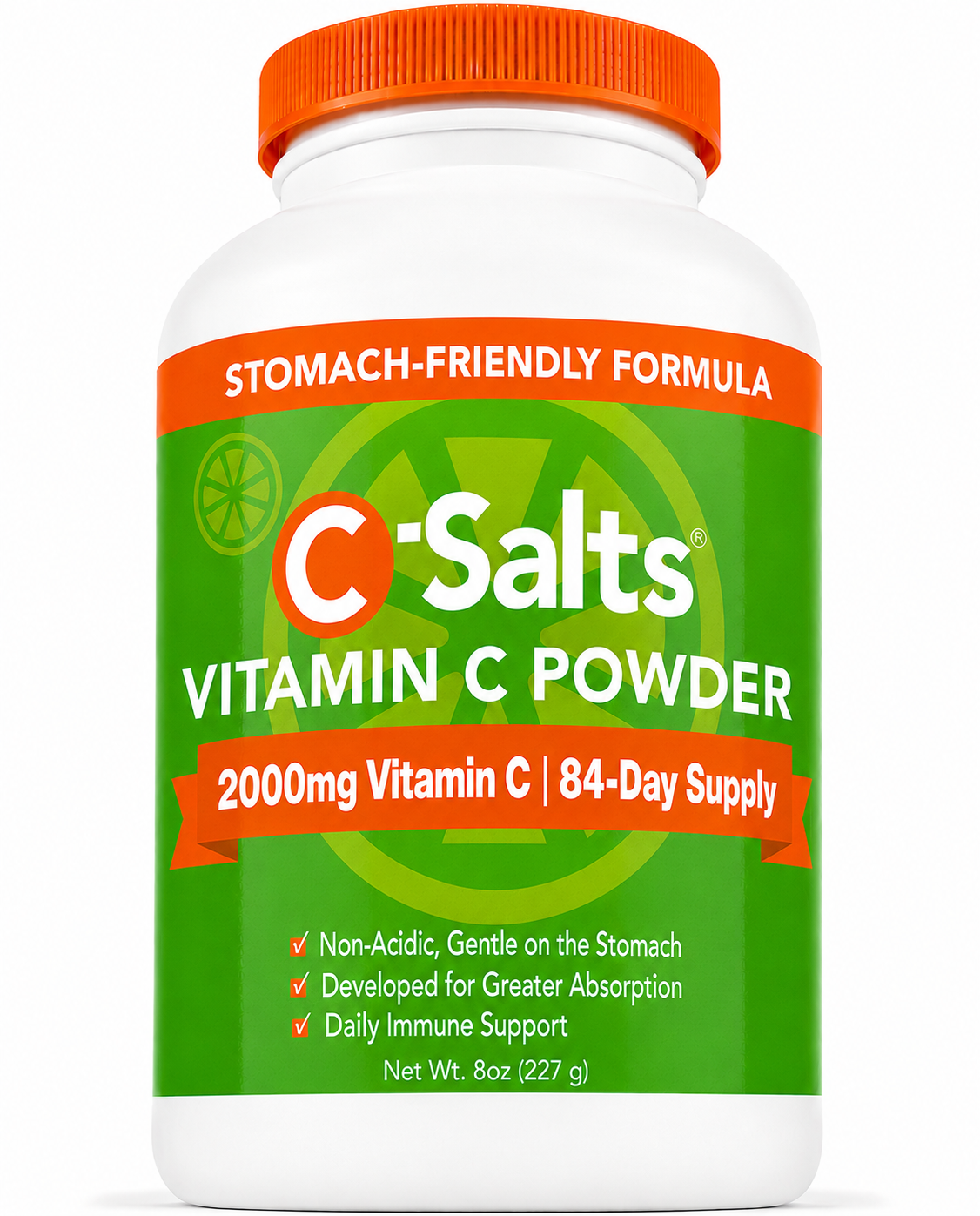
C-Salts® Buffered Vitamin C Powder
Discover the low-acid, four-mineral vitamin C powder developed by Wholesale Nutrition founder Oscar Falconi.
- 2,000 mg vitamin C per half-teaspoon serving
- Buffered, low-acid formulation
- Calcium, magnesium, potassium and zinc
- Stomach-friendly vitamin C
- Sugar-free and sodium-free
- Vegan and non-GMO
- Four flavors and two sizes
- More than 50 years of Wholesale Nutrition heritage

Frequently Asked Questions
Who invented C-Salts buffered vitamin C?
C-Salts was developed by Oscar Falconi, an MIT-educated physicist who founded Wholesale Nutrition Club in 1970. His objective was to develop a low-acid, sodium-free vitamin C powder containing four essential minerals.
Were Oscar Falconi and Linus Pauling friends?
According to the Falconi family, they were personal friends. Historical company records, a personally inscribed book and a humorous signed note about a one-dollar wager document their association. A January 1983 newsletter also describes Pauling's attendance at a gathering at Falconi's home in November 1982.
Did Linus Pauling help develop C-Salts?
According to Falconi family history, Pauling offered input during development and spoke favorably about C-Salts at seminars. Independent auction records confirm correspondence with Falconi and awareness of C-Salts, but do not establish the extent of his formulation contributions or verify seminar recommendations.
Is there independent historical documentation connecting Linus Pauling to C-Salts?
Yes. RR Auction published records of two 1971 letters from Pauling to Oscar Falconi and a March 1981 letter from Pauling to Irwin Stone mentioning C-Salts by name. These records are linked in the independent historical documentation section above.
Was Dr. Robert Cathcart involved with C-Salts?
An original letter dated August 11, 1982, documents Dr. Cathcart's direct correspondence with Oscar Falconi concerning the buffering ingredients and mineral ratios of C-Salts.
Did Dr. Andrew Weil recommend C-Salts?
Historical company records attribute C-Salts recommendations to two of Dr. Weil's published books: Natural Health, Natural Medicine and 8 Weeks to Optimum Health. The original passages remain pending independent verification. These are historical references rather than statements of current endorsement.
What makes C-Salts different from regular vitamin C?
C-Salts combines vitamin C with calcium, magnesium, potassium and zinc in a buffered, low-acid powder. It is designed for consumers who prefer a less acidic alternative to plain ascorbic acid.
How much vitamin C is in C-Salts?
Each half-teaspoon serving provides 2,000 mg of vitamin C. C-Salts is available in Original, Blood Orange, Mixed Berry and Lemon Lime flavors.
Historical Sources and Documentation
This page draws upon historical materials preserved by Wholesale Nutrition and the Falconi family, including:
- Family archive photograph and signed calculator-wager note given to Oscar Falconi by Linus Pauling, according to family provenance; date unknown.
- Linus Pauling's personally inscribed copy of Vitamin C, the Common Cold and the Flu.
- Wholesale Nutrition Club Vitamin C Seminar program, October 4, 1981.
- Robert F. Cathcart III, M.D., correspondence to Oscar Falconi, August 11, 1982.
- Wholesale Nutrition Club Newsletter No. 13, September 1982.
- Wholesale Nutrition Club Newsletter No. 14, January 1983.
- Wholesale Nutrition Club Newsletter No. 16, September 1983.
- Wholesale Nutrition Club Newsletter No. 18, May 1984.
- Historical company references to Andrew Weil's published books.
- RR Auction, Lot 248, October 15, 2014: Pauling correspondence with Falconi, 1971.
- RR Auction, Lot 247, October 15, 2014: Pauling correspondence with Stone, March 1981.
Historical documents are presented for educational and archival purposes. They reflect the ideas and discussions of their time and should not be interpreted as current medical advice, proof of clinical effectiveness, or evidence of current endorsements. Historical formulations and serving sizes may differ from today's products. Family recollections are distinguished from independently documented records. The digitally adapted Oscar Falconi portrait is illustrative, not an unaltered archival photograph. Pauling's Nobel Prizes were not awarded for vitamin C research or C-Salts.
These statements have not been evaluated by the Food and Drug Administration. This product is not intended to diagnose, treat, cure or prevent any disease.