
Best Buffered Vitamin C Supplements: Powder vs. Capsules & Tablets
Looking for the best buffered vitamin C supplements? Choosing between powders, capsules and tablets starts with understanding their ingredients, convenience, serving sizes and value.
Buffered vitamin C supplements commonly contain mineral ascorbates that provide a lower-acid alternative to traditional ascorbic acid. This guide compares the available formats and explains why C-Salts® Buffered Vitamin C Powder may be a good choice for shoppers seeking vitamin C with electrolytes.
Buffered Vitamin C Supplements Compared
| Feature | Buffered Powder | Buffered Capsules | Buffered Tablets |
|---|---|---|---|
| How it's taken | Mixed with a beverage | Swallowed | Swallowed |
| Serving flexibility | Measured powder servings | Premeasured amounts | Premeasured amounts |
| Convenience | Requires mixing | Portable | Portable |
| Swallowing pills | Not required | Required | Required |
| Value | Larger containers may offer savings | Varies by brand | Varies by brand |
Why Choose C-Salts Buffered Vitamin C Powder?
C-Salts® is a stomach-friendly, low-acid buffered vitamin C powder formulated with mineral ascorbates and electrolytes. It provides 2,000 mg of vitamin C per serving and is available in four flavors and two bottle sizes.
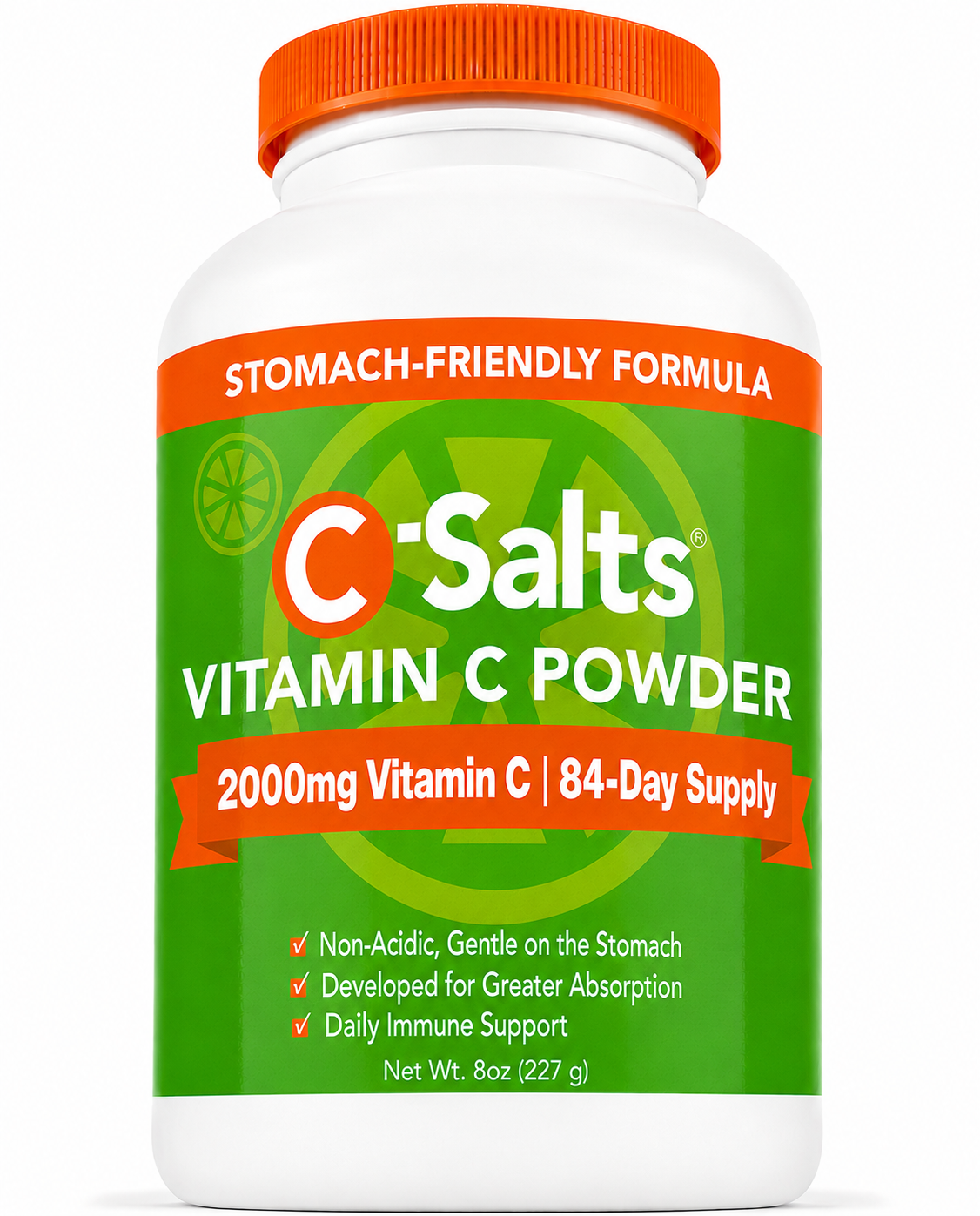
Click the bottle to shop C-Salts Original 8 oz.
What Makes C-Salts Different?
- 2,000 mg Vitamin C Per Serving
- Low-Acid, Stomach-Friendly Buffered Formula
- Vitamin C + Electrolytes
- Four Flavors: Original, Lemon Lime, Blood Orange and Mixed Berry
- Two Sizes: 8 oz and 26 oz
- Approximately 246 Servings in the 26 oz bottle
- Vegan, Non-GMO & Sugar-Free
- Trusted for Over 50 Years

Click above to read C-Salts customer reviews on Amazon.
How to Choose the Best Buffered Vitamin C Supplement
1. Look at the Ingredients
Buffered vitamin C supplements may contain mineral ascorbates such as calcium ascorbate, magnesium ascorbate, potassium ascorbate or sodium ascorbate. Compare the ingredient labels to understand what each product contains.
2. Compare Vitamin C Per Serving
Vitamin C amounts vary widely among buffered supplements. C-Salts provides 2,000 mg of vitamin C per labeled serving, making it a high-dose option. More vitamin C is not necessarily better for everyone, so follow label directions and consider your total daily intake.
3. Consider Powder vs. Capsules and Tablets
Buffered vitamin C powders are ideal for shoppers who prefer mixing supplements into drinks. Capsules and tablets offer premeasured convenience, particularly for travel.
4. Compare Cost Per Serving
When evaluating buffered vitamin C supplements, compare cost at equivalent vitamin C amounts rather than only bottle price. Larger containers may provide a more economical option.
Frequently Asked Questions About Buffered Vitamin C Supplements
What are the best buffered vitamin C supplements?
The best buffered vitamin C supplement depends on your preferred format, vitamin C amount, ingredients and budget. Buffered powders such as C-Salts are an option for customers who prefer drinkable supplements, while capsules and tablets offer portable convenience.
Are buffered vitamin C supplements non-acidic?
Buffered vitamin C supplements are generally formulated to be lower in acidity than traditional ascorbic acid. However, low-acid and completely non-acidic are not necessarily the same thing.
Is buffered vitamin C gentler on the stomach?
Some shoppers prefer buffered vitamin C because of its lower-acid formulation. Individual tolerance varies, however, and buffered vitamin C is not guaranteed to prevent digestive discomfort.
Is buffered vitamin C powder better than capsules?
Neither form is universally better. Powder allows mixing with beverages and avoids swallowing pills. Capsules provide portability and convenient premeasured servings.
How much vitamin C should I take?
Vitamin C requirements vary. The established tolerable upper intake level for adults is 2,000 mg per day from all sources. Consult a healthcare professional if you have questions about high-dose vitamin C supplementation.
Explore More Vitamin C Guides
- Which Vitamin C Is Best for Me?
- Non-Acidic Vitamin C Powder Guide
- Buffered Vitamin C vs. Ascorbic Acid
- Best Value Vitamin C Powder
Educational reference: NIH Office of Dietary Supplements - Vitamin C Fact Sheet . This guide is for general educational purposes and is not medical advice.