
Best Value Vitamin C Powder: How to Compare Cost Per Serving
Looking for the best value vitamin C powder? The lowest-priced bottle isn't necessarily the most economical choice. Container size, vitamin C content, serving count, and formulation all affect how much you actually pay.
Whether you're comparing bulk vitamin C powder, affordable ascorbic acid powder, or buffered vitamin C with electrolytes, this guide explains how to evaluate value and choose a product that fits your needs.
What Makes a Vitamin C Powder a Good Value?
When comparing vitamin C supplements, it's important to look beyond the advertised price. A larger bottle may cost more upfront but provide substantially more servings.
Consider these factors:
- Cost per serving: Divide the container price by the number of labeled servings.
- Vitamin C per serving: Compare the amount of vitamin C in each serving.
- Total vitamin C content: Calculate the total amount of vitamin C supplied by the container.
- Ingredients: Determine whether the formula contains plain ascorbic acid, mineral ascorbates, or other ingredients.
- Container size: Larger packages sometimes provide better value.
- Quality and preferences: Consider labeling, testing information, taste, and convenience.
How to Calculate Vitamin C Powder Cost Per Serving
One of the simplest ways to compare vitamin C powders is to calculate the cost of each labeled serving.
Cost Per Serving = Container Price / Number of Servings
For example, a $30 container with 150 servings costs $0.20 per serving.
However, serving sizes can differ significantly between brands. One product may provide 500 mg of vitamin C per serving while another provides 2,000 mg.
For a fairer comparison of vitamin C quantity, you can also calculate the cost per 1,000 mg of vitamin C.
Cost Per 1,000 mg = Container Price / Total Vitamin C (in 1,000 mg units)
This helps compare products with different serving strengths without assuming that everyone needs the same daily dose.
Bulk Vitamin C Powder vs. Smaller Containers
Buying vitamin C powder in bulk can be economical for people who use the product regularly. Larger containers often reduce packaging costs per serving, although actual savings depend on the price and formulation.
Advantages of Larger Containers
- Potentially lower cost per serving
- Fewer repeat purchases
- More servings in a single package
- Convenience for regular users
When Smaller Containers Make Sense
Smaller bottles may be preferable when trying a new flavor or formulation, when storage space is limited, or when you use vitamin C infrequently.
Check expiration dates and storage instructions before purchasing large quantities. Powder should be kept according to the manufacturer's recommendations to protect product quality.
Vitamin C Powder Value Comparison
Different vitamin C powders can offer value in different ways. The table below compares common product categories rather than specific brands or temporary sale prices.
| Type | Main Characteristics | Value Considerations |
|---|---|---|
| Pure Ascorbic Acid Powder | Typically single-ingredient, acidic vitamin C | Compare price per 1,000 mg of vitamin C |
| Buffered Vitamin C Powder | Lower-acid formulation containing mineral ascorbates | Consider acidity, minerals, and cost per serving |
| Flavored Vitamin C Powder | May contain flavors or sweeteners | Consider taste, ingredients, and serving count |
| Bulk Vitamin C Powder | Larger packages intended for multiple servings | Compare unit price, freshness, and expected usage |
Is the Cheapest Vitamin C Powder Always the Best?
No. Price is only one part of a vitamin C supplement's overall value.
A low-cost product may be appropriate if you simply want plain ascorbic acid. Other shoppers may prefer a buffered vitamin C powder, additional minerals, a particular flavor, or a product with documented quality testing.
Neither buffered vitamin C nor a more expensive formulation is automatically better absorbed than standard ascorbic acid.
How Much Does C-Salts Vitamin C Powder Cost Per Serving?
C-Salts® Buffered Vitamin C Powder is available in two sizes: an 8 oz bottle with approximately 76 servings and a 26 oz bottle with approximately 246 servings.
Each labeled serving provides 2,000 mg of vitamin C along with electrolyte minerals.
Using example regular prices of $24.95 for the 8 oz bottle and $44.95 for the 26 oz bottle, the approximate cost per serving is:
| C-Salts Size | Approx. Servings | Example Price | Cost Per Serving |
|---|---|---|---|
| 8 oz | 76 | $24.95 | $0.33 |
| 26 oz | 246 | $44.95 | $0.18 |
Prices are illustrative and may change. Serving counts are approximate; refer to the current product label and selling price.
At these example prices, the 26 oz bottle costs approximately 45% less per serving than the 8 oz bottle. That makes it an attractive option for shoppers who use C-Salts regularly and prefer a larger container.
Looking for a Value-Priced Buffered Vitamin C Powder?
C-Salts combines low-acid buffered vitamin C with electrolytes in a powder available in Original, Lemon Lime, Blood Orange, and Mixed Berry.
The formula is vegan, Non-GMO, and sugar-free. For regular users, the larger 26 oz bottle may provide particularly attractive value per serving.

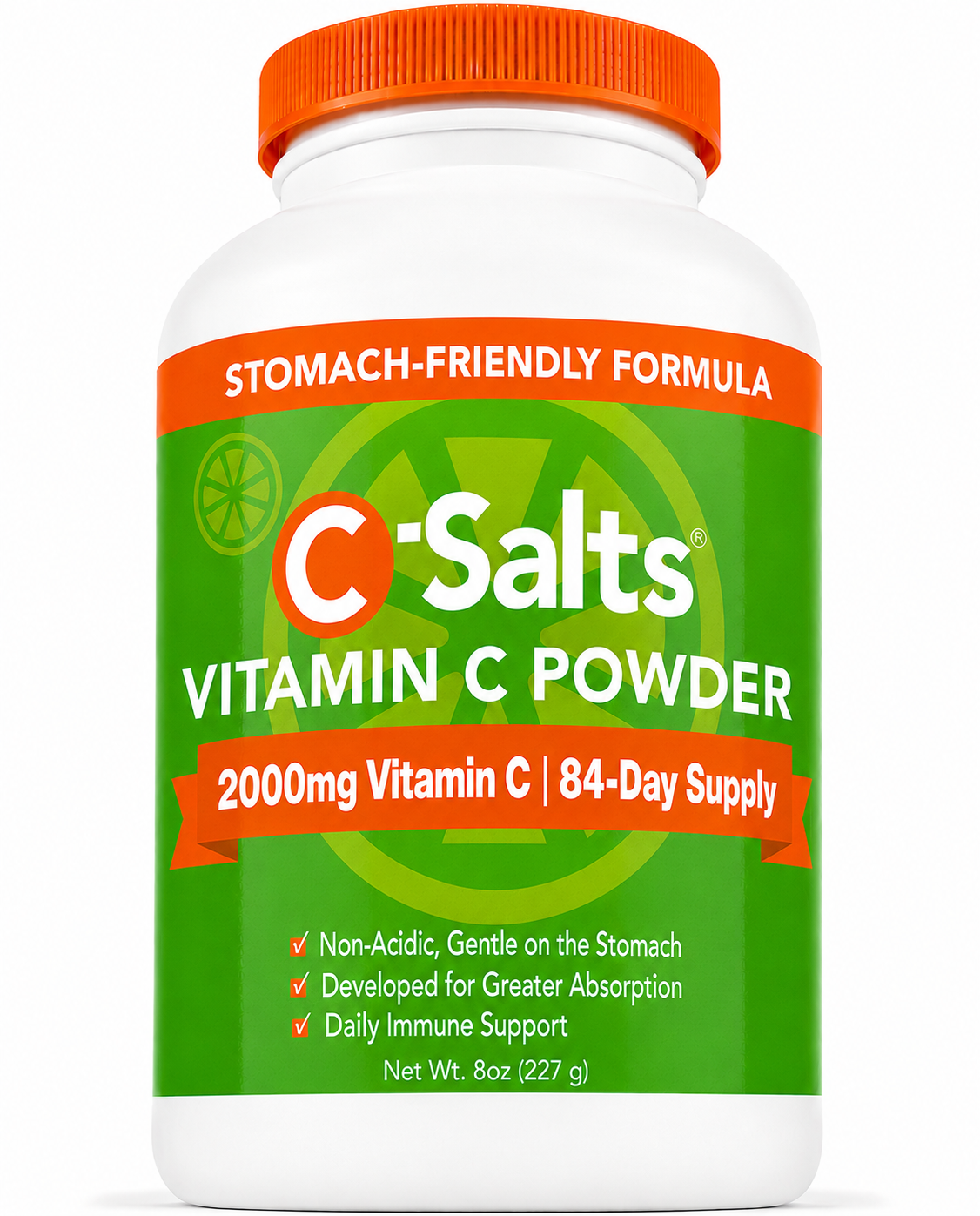
BUFFERED VITAMIN C + ELECTROLYTES
Discover C-Salts® Buffered Vitamin C Powder
2,000 mg Vitamin C Per Serving
Enjoy a low-acid buffered vitamin C powder with electrolytes, available in two convenient sizes.
- Approximately 246 servings in the 26 oz bottle
- 2,000 mg vitamin C per serving
- Stomach-friendly, low-acid formulation
- Vitamin C plus electrolytes
- Vegan, Non-GMO and sugar-free
- Four flavor options
Trusted for Over 50 Years
Frequently Asked Questions
What is the best value vitamin C powder?
The best value depends on price, serving count, vitamin C content, formulation, and personal preferences. Compare both cost per serving and cost per 1,000 mg of vitamin C.
Is buying vitamin C powder in bulk cheaper?
It can be. Larger packages sometimes have a lower unit cost, but prices vary by brand and formulation. Check the total cost, number of servings, and expected usage.
Is buffered vitamin C more expensive than ascorbic acid?
Some buffered formulations cost more than plain ascorbic acid, but this is not always the case. Compare actual prices and vitamin C content rather than assuming one type is more expensive.
How do I compare vitamin C powders with different serving sizes?
Calculate cost per serving and cost per 1,000 mg of vitamin C. Then consider ingredients, acidity, taste, and other features that matter to you.
Does more vitamin C per serving mean better value?
Not necessarily. A higher vitamin C amount does not automatically mean greater benefit. The appropriate intake depends on individual needs, and absorption efficiency decreases at higher doses.
How much vitamin C can adults take daily?
For most adults, the tolerable upper intake level is 2,000 mg per day from all sources combined. High supplemental doses may cause digestive discomfort. Consult a healthcare professional if you have questions about your intake.
Explore More Vitamin C Guides
- Which Vitamin C Is Best for Me?
- Best Buffered Vitamin C Powders Compared
- Non-Acidic Vitamin C Powder Guide
- Buffered Vitamin C vs. Ascorbic Acid
- Vitamin C Powder vs. Tablets and Capsules
This article is for general educational purposes and is not a substitute for individualized medical advice.